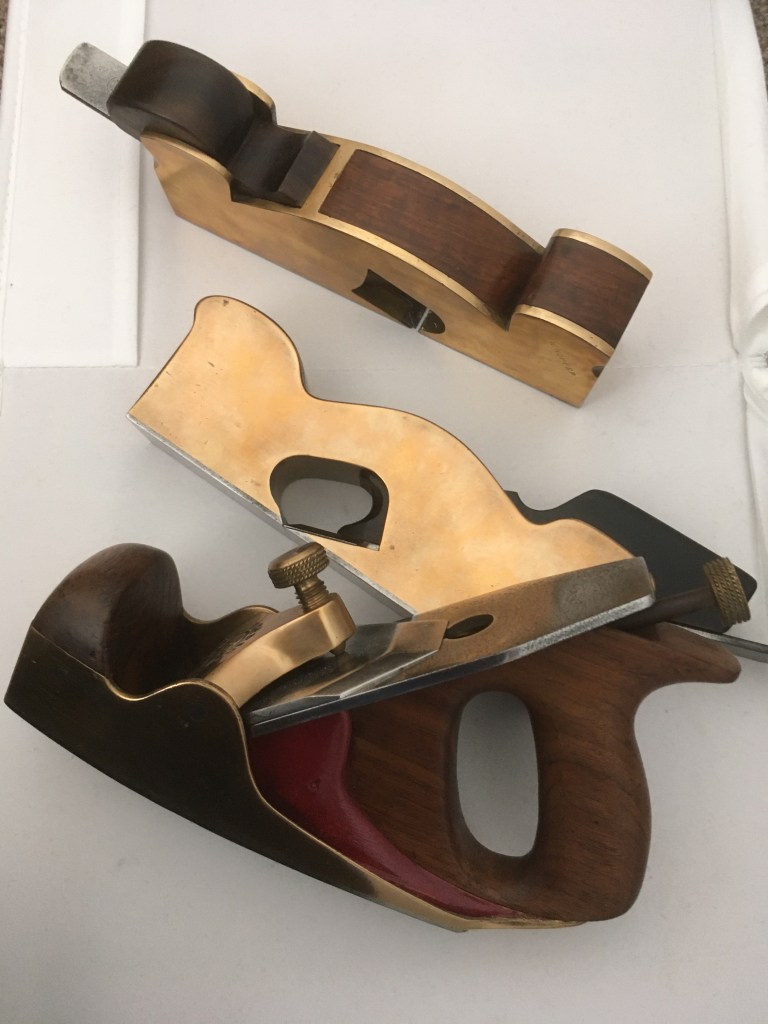
I’ve always been fascinated by the craftsmanship behind classic British hand planes, especially those made by Norris of London. Their tools are revered not just for their performance, but for the elegance and precision of their construction. Yet one detail has always puzzled me: how did Norris attach the steel soles to their brass-bodied planes?
With Spiers of Ayr, the answer is plain to see. Their planes feature visible dovetailing—mechanical joints that lock the steel sole to the sides of the body. It’s a beautiful and honest technique, one that speaks to the maker’s skill. But Norris? Their brass planes often show no such dovetails. The joint between sole and body is seamless, almost mysterious.
When I tried to uncover the exact process, I was told that the soles were “sweated on.” At first, I took this to mean some kind of soldering was involved. But what does “sweating on” really entail?
🔧 What Is Sweating?
In metalworking, sweating refers to a soldering or brazing method where two metals are joined by heating them until a filler metal melts and flows between the surfaces. Once cooled, the bond is strong and clean—perfect for a tool where aesthetics and durability matter.
In the case of Norris planes, this technique would involve heating the brass body and steel sole together with solder in between, allowing the molten metal to wick into the joint. The result? A flawless surface with no visible fasteners, perfectly aligned and polished.
🕵️♂️ Clues and Speculation
Some collectors and restorers have examined Norris planes closely and found no signs of dovetailing or mechanical pins. This supports the sweating theory. Others speculate that Norris may have used hidden pins or rivets, ground flush and invisible to the eye. Without destructive testing, it’s hard to say for certain.
There are also subtle clues—discoloration along the joint, faint seams, or slight variations in finish—that suggest soldering was indeed used. It’s a technique that would have allowed Norris to maintain their high standards of fit and finish while streamlining production.
🪚 Why Not Dovetail?
Dovetailing, while beautiful, is labour-intensive. Sweating the sole on would have been faster and more efficient, especially for brass-bodied planes where the aesthetic demanded a smooth, uninterrupted surface. It’s likely that Norris used dovetailing on some early models, but transitioned to sweating for later production.
📣 Calling All Experts
The truth may lie buried in workshop lore or hidden in the archives of Norris’s production history. If anyone out there has firsthand knowledge—perhaps from restoration work, old catalogues, or surviving correspondence—I’d love to hear from you. This mystery is part of what makes vintage tools so compelling: they’re not just objects, but stories waiting to be uncovered.

 The old tool collector