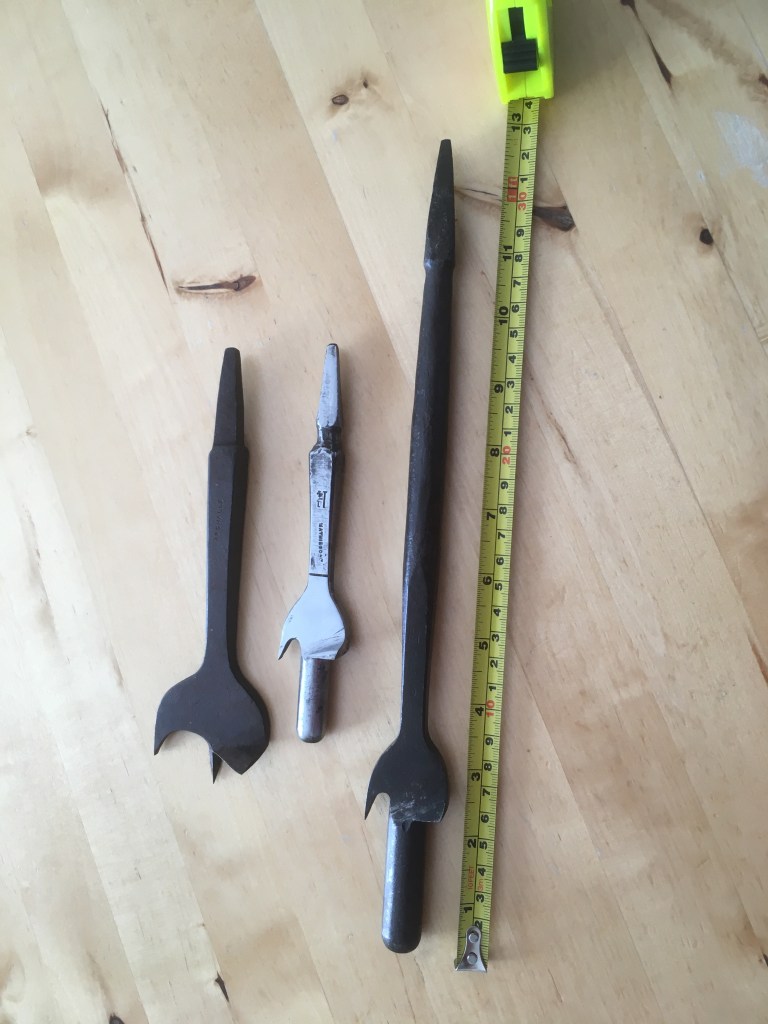
In the past, craftspeople, particularly shipwrights, used specialised bits for creating and plugging holes in decking. These antique tools are now primarily collector’s items.
- Shipwright’s dowelling bit: These tools, often marked by makers like Mathieson or David Flather, were also known as plug center bits.
- Function: The bit counterbored a hole for a fastener and also cut a precisely fitting dowel (or “bung”) to cover the screw or bolt head. The dowel was then glued in place to create a smooth, flush finish.
Modern plug-cutting methods
Today, the process of plugging screw holes is achieved with modern tools, often in kit form, which provides a clean and finished look for unpainted decks.
- Plug cutter: A plug cutter is a drill press attachment that cuts plugs with a slight taper from a piece of scrap decking. This is ideal for matching the wood grain of the plug to the deck board for a nearly invisible repair.
- Forstner or spade bit: For a less refined but still effective approach, a Forstner or spade bit can be used to drill the initial hole.
- Installation: After drilling the hole and driving the screw, a wooden dowel is glued in, tapped into place, and cut flush with a flush-cut saw.
Removing old dowels
If you need to remove old, rotted, or broken dowel plugs, a few tools can help:
- Plug cutter: Drill around the dowel with a plug cutter that has a larger diameter than the original dowel to cleanly remove it.
- Drill bit: You can use a drill bit of the same size or slightly smaller to bore into the center of the old dowel. This will weaken the wood and allow you to pry it out.
- Extractor or puller: While more for industrial or mechanical dowels, specialised pin pullers and extractors exist for stubborn pins and can be adapted for wood
 The old tool collector