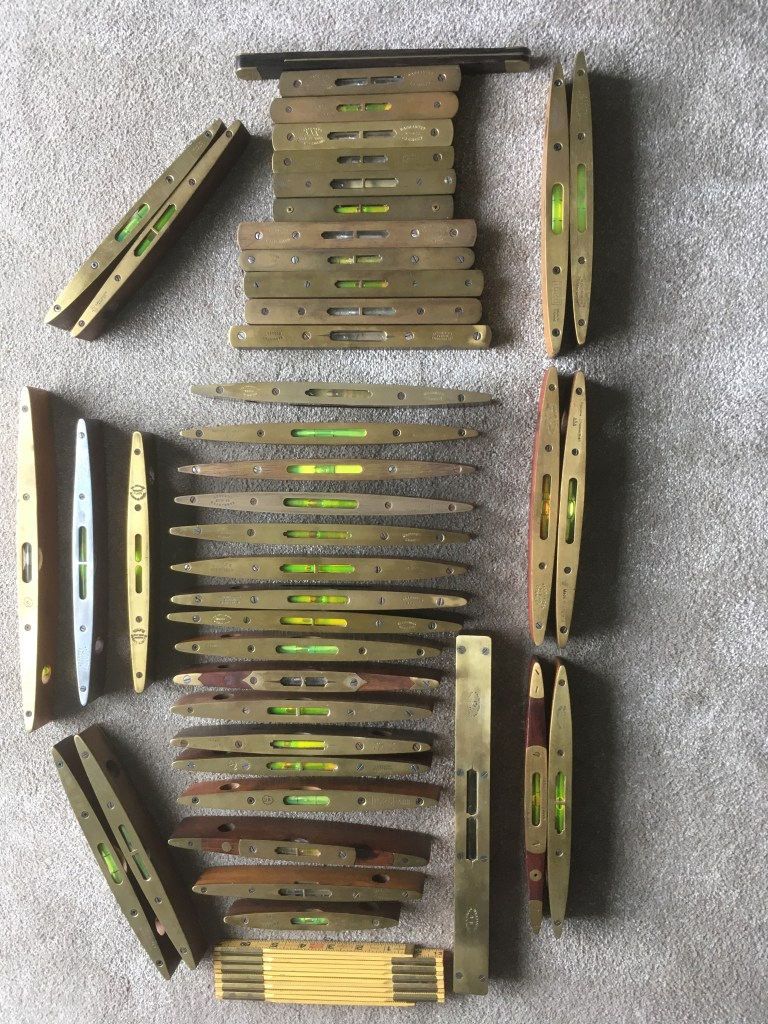
History of Rabone, Smallwood, and Hockley Abbey in British Carpenter’s Levels
1. John Rabone & Sons (later Rabone Chesterman)
Origins (c.1780–1784) The Rabone story begins with Michael Rabone, who was already working as a rule‑maker at 8 Snow Hill, Birmingham around 1780. By 1784, the business had formally taken shape as a maker of rules and measuring tools.
19th‑century expansion
The firm was carried forward by John Rabone (Senior) and later John Rabone (Junior).
By the mid‑1800s, the company was producing barometers, thermometers, folding rules, and other precision tools.
In 1871, the company moved its operations to the now‑famous Hockley Abbey Works in Birmingham.
In 1872, Rabone’s newly patented spirit levels and rules were exhibited internationally in Moscow, Vienna, Sydney, and Melbourne — a sign of their growing reputation.
20th century and merger
Rabone remained a family‑controlled firm until 1962.
In 1963, it merged with James Chesterman & Co. of Sheffield, becoming Rabone Chesterman, a name familiar to many tool collectors today.
A new factory opened in 1984 at Summer Hill, Birmingham.
As late as 2008, business activity was still recorded at Hockley Abbey.
Products Rabone was known for:
Hardwood and brass spirit levels
Folding boxwood rules
Measuring tapes
Precision engineering tools Their levels — such as the No. 1621 and canoe‑shaped No. 1625 — became standards of British craftsmanship.
2. Smallwood (J. Smallwood & Co.)
Smallwood, the name is historically associated with rule‑making and measuring tools in Birmingham, and Smallwood products often appear alongside Rabone tools in collections and catalogues.
Important note: Smallwood was not part of Rabone, but operated in the same Birmingham tool‑making ecosystem. Many collectors group them together because their tools — especially rules and levels — share similar materials, construction, and period.
3. Hockley Abbey (the factory, not a monastery)
Hockley Abbey was the name of the large industrial works in Birmingham where Rabone operated from 1871 onward.
Despite the name, it was not a religious abbey — the site was an industrial complex in the Hockley district, part of Birmingham’s Jewellery Quarter and tool‑making heartland.
Why Hockley Abbey matters
It became the central manufacturing site for Rabone’s rules, levels, and tapes.
It symbolised the company’s industrial identity — so much so that their telegraphic address was simply “Abbey, Birmingham.”
The works appear in 19th‑century engravings and advertisements, showing a sprawling, modern factory for its time.
Later years
Even after the Rabone Chesterman merger, the Hockley Abbey site remained active well into the late 20th century, and some business activity was still recorded there in 2008